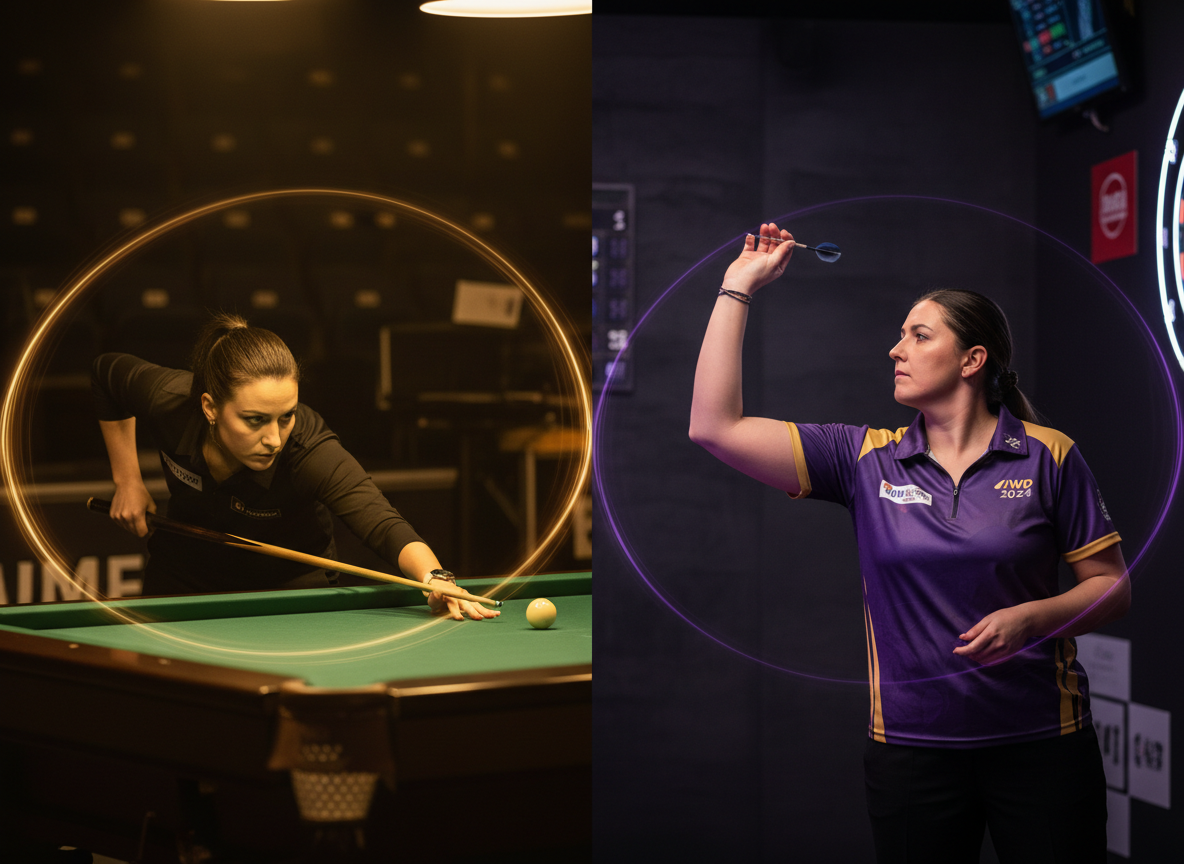
Every year, around tournaments and highlight reels, the same comment pops up: "In billiards and darts there's no strength involved, so there's no reason women should perform less than men."
On the surface it sounds logical. These aren't power sports.
But it's also a shortsighted take — because it reduces performance to mechanics only, and ignores the reality that high-level performance is built on the body + the brain + the nervous system. And for many women, those systems are influenced by hormonal phases that men simply never have to live through.
The "no strength needed" myth
In precision sports, tiny changes matter. A few percent difference in sleep, pain, focus, anxiety, or energy can be the difference between:
- •staying patient on a long safety battle
- •keeping a smooth cue action under pressure
- •trusting your throw in a deciding leg
- •making the right decision when the match gets tight
Women may have to compete while navigating factors like:
- •Hormonal cycle changes (month to month)
- •Menstruation (sometimes with heavy pain, fatigue, migraines, digestive issues)
- •Pregnancy and postpartum recovery
- •Perimenopause and menopause (often with sleep disruption, mood swings, brain fog, hot flushes, anxiety spikes)
None of this is "an excuse." It's context. And context is exactly what performance coaching is about.
It's not only physical: the brain shifts too
One of the most overlooked parts: hormones don't just influence cramps or energy. They also influence how the brain runs its software.
High level, across a month (and even more during peri- and postmenopause), many women notice shifts in:
- •attention and concentration
- •emotional regulation
- •stress sensitivity
- •confidence and self-talk
- •recovery after a mistake
- •decision speed and risk tolerance
In billiards and darts, those aren't "nice-to-haves." They're performance drivers.
And here's the game changer: women can learn to work with these shifts — by exploiting phase-specific strengths, compensating for predictable vulnerabilities, and building routines that stay stable even when the internal state isn't.
A simple way to think about it (without overcomplicating it)
Every woman is different, but many athletes recognize a pattern like this:
High-capacity phases: easier focus, better learning, more confidence, more creative problem-solving.
Management phases: more fatigue, more emotional noise, more sensitivity to pressure — so performance becomes more about simplicity, routines, and regulation.
The goal isn't to "be the same every day." The goal is to know what you can lean on today.
The Fallon Sherrock example: a double standard
Fallon Sherrock recently commented on male players like Michael van Gerwen (and others) not competing because they "didn't feel good." Her point landed hard: for many women, feeling physically off is a regular reality during their period — yet they still show up.
The backlash she received says a lot.
When a male athlete says he doesn't feel right, it's often framed as professionalism: "He knows his body." When a woman points out that she competes through pain and hormonal symptoms, it's too often framed as complaining.
That double standard doesn't just hurt women — it also blocks honest conversations that could improve performance and wellbeing.
Why mental preparation can't be copy-paste
Mental preparation for women in billiards and darts often needs a different approach — not because women are "weaker," but because the variables are different.
Here are a few practical mindset shifts that can make a big difference:
1) Plan your season like a pro (with your body in mind)
Instead of forcing the same expectations every week, build a performance plan that respects reality:
- •track energy, sleep, pain, mood, focus
- •identify "high-performance windows" and "management windows"
- •adjust goals: sometimes the win goal becomes a process goal (routine, decision-making, emotional control)
2) Train a "reset system," not just motivation
When hormones amplify emotions, the key isn't hype — it's regulation:
- •breathing routines between racks/legs
- •short cue words ("smooth", "commit", "next shot")
- •a mistake protocol (what you do immediately after a miss)
3) Build confidence that survives fluctuations
Confidence shouldn't depend on feeling perfect.
The goal is a mindset that says:
- •"I can compete even if I'm not 100%."
- •"My job is to execute my process."
- •"My level can be different today, and I can still be dangerous."
4) Normalize the conversation
The more we treat female physiology as taboo, the more women are forced to suffer in silence — and the more the sport loses talent.
Coaches, federations, teammates, and partners can help simply by:
- •listening without judgment
- •allowing athletes to plan and communicate
- •respecting that performance isn't only technique
The real point
International Women's Day isn't about saying women need special treatment.
It's about acknowledging that equal opportunity requires understanding real differences — and that in precision sports like billiards and darts, the "invisible factors" matter.
So the next time someone says, "There's no reason women should perform less," maybe the answer is:
There are plenty of reasons performance can be harder to stabilize — yet many women still show up, compete, and win.
And that deserves respect.
Invitation
If you're a female billiards or darts player and you want to compete with more consistency — even on the days your body and brain don't feel "ideal" — send me a message.
We'll look at your competition routine, your pressure triggers, and how to build a simple, cycle-aware mental game plan that helps you show up with confidence.