Is Mindset Training for Me? 8 Real Scenarios for Pool & Carom Players
You don't need to be "weak mentally" to benefit from mindset training. Most players who improve fast already have a technical base — what holds them back is how they handle pressure, mistakes, focus, and confidence.
Nicky Defraeye
Champion Mindset Coach
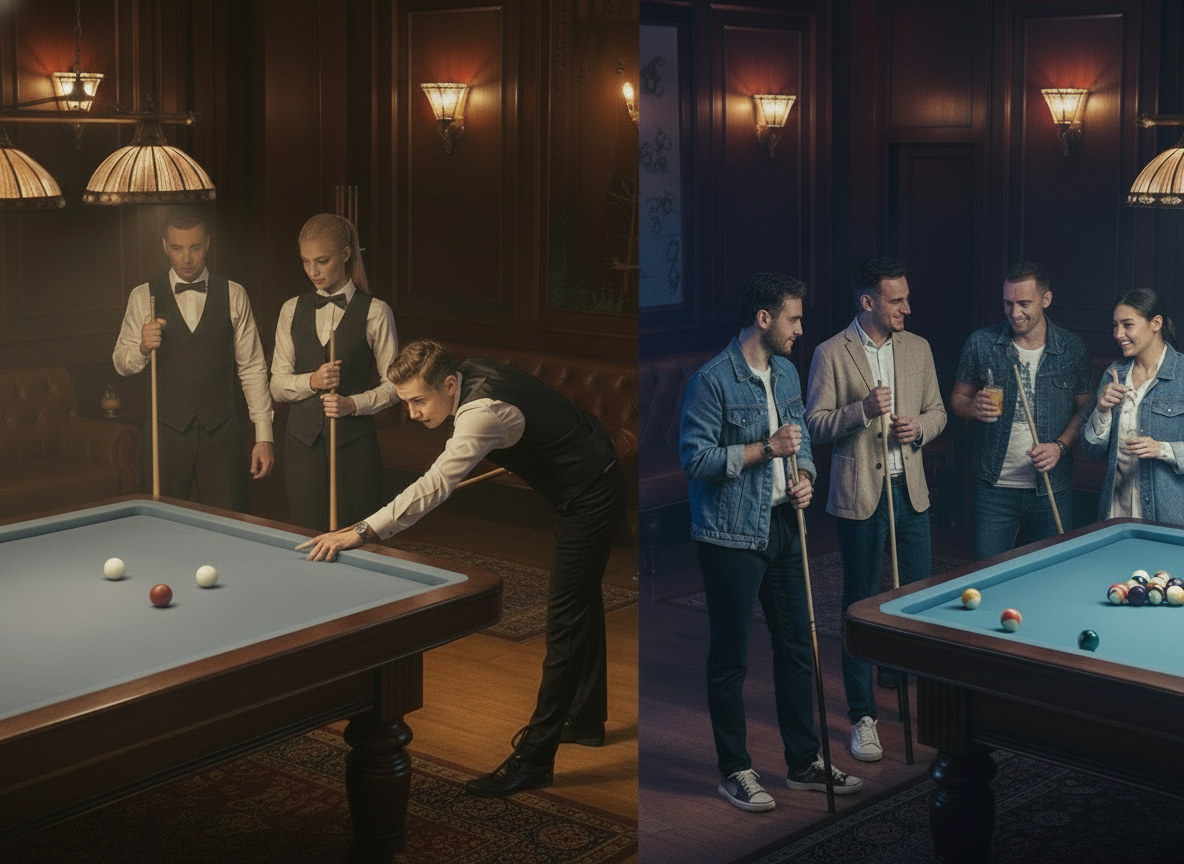
Below are 8 short stories (from beginner to high-level) for pool and carom players. If you recognize yourself in even one, mindset training is probably for you.
A quick note before the stories: level doesn't decide if mindset training helps
Mindset training isn't "for beginners" or "only for elite players." Level doesn't automatically equal mental strength. A beginner can have a naturally strong mindset (calm, curious, resilient) and progress fast. And an elite player can suddenly struggle — not because they lost skill, but because something changed: a physical issue, a drop in ranking, extra expectations, or the same negative pattern showing up in big games or against big competitors.
The scenarios below are labelled from beginner to elite because certain challenges tend to surface more at particular stages — but in reality, any of these scenarios can happen to a player at any level. The labels are simply there to show that no matter where you are in your journey, there are always mindset aspects worth working on.
The real question is simple: can you identify one aspect of your game that isn't optimal right now? If yes, a mindset reframe or a structured mindset training plan can help you rebuild stability and performance — whatever your level.
Scenario 1: "I play great in practice, but I choke in matches"
BeginnerYou've done the work. Your technique is solid. In practice, you make shots that would impress anyone watching. But the moment a match starts — especially an important one — something shifts.
Your cue action tightens. Your breathing gets shallow. You start second-guessing decisions you'd normally make without thinking. The gap between your practice level and your match level feels frustrating — because you know the ability is there.
What's actually happening:
Your nervous system is interpreting the match as a threat instead of a challenge. The stress response kicks in — heart rate up, muscles tense, fine motor control drops. This isn't a character flaw. It's a trainable pattern. With the right pre-match routine, breathing protocol, and reframing techniques, you can teach your body to stay in "performance mode" instead of "survival mode."
Scenario 2: "One miss and my whole game falls apart"
BeginnerYou're playing well. Rhythm is good. Confidence is building. Then you miss a shot — maybe not even a difficult one. And instead of moving on, something inside you shifts. The miss replays in your head. You start thinking about what you did wrong. Your next shot feels heavier. Then the next one. Before you know it, one miss has become three, and the match has slipped away.
What's actually happening:
You're missing a reset skill. The miss itself isn't the problem — it's what happens in the 5–10 seconds after. Your brain gets stuck in "error mode" instead of switching back to "execution mode." This is one of the most common patterns in billiards and darts, and it's very trainable. A simple 3-second reset protocol (name it, breathe, next task) can break the spiral before it starts.
Scenario 3: "I've hit a plateau — I keep training but nothing changes"
SkilledYou've been playing for years. You know the game well. You train regularly. But your results have flatlined. You're not getting worse — but you're not getting better either. It feels like there's an invisible ceiling, and no matter how many hours you put in, you can't break through it.
What's actually happening:
Plateaus are rarely only technical. Often, the technical skill is there — but the mental framework hasn't evolved. You might be training without clear process goals, repeating comfortable patterns instead of challenging yourself, or lacking the mental structure to transfer practice gains into match performance. Mindset coaching helps you identify what's actually blocking the next level — and it's often not what you think.
Scenario 4: "I overthink every shot — I can't get out of my own head"
SkilledYou stand over the ball and your mind starts racing. Should I use more speed? Less spin? What if I miss the contact point? You calculate, recalculate, adjust — and by the time you finally pull the trigger, the natural flow is gone. The shot feels forced. Mechanical. You know you play better when you "just play" — but you can't seem to stop the analysis.
What's actually happening:
You're stuck in the wrong concentration mode. The Methode Target describes four modes of attention (SESA): large-internal (analyze), narrow-internal (prepare), narrow-external (execute), and large-external (evaluate). Overthinking means you're staying in analysis mode when you should be switching to execution mode. Training the switch — through pre-shot routines and cue words — gives your brain a clear signal: "Decision made. Now execute."
Scenario 5: "I lose focus during long matches — I drift off"
CompetitiveThe first few frames go well. You're sharp, present, engaged. But as the match stretches on — especially in tournaments with multiple matches per day — your concentration starts to wander. You catch yourself thinking about the score, the next opponent, what you'll eat after, or replaying something from earlier. By the time you snap back, you've already lost momentum.
What's actually happening:
Concentration is not a switch you flip once — it's a muscle that fatigues. Long matches require trained mental stamina, not just willpower. The key is learning when to concentrate fully (during your turn) and when to deliberately downshift (between turns). This "concentration rhythm" preserves energy for the moments that matter most. It also helps to have a simple refocus cue — a physical or verbal trigger that brings you back to the present shot.
Scenario 6: "I play well against weaker opponents but freeze against strong ones"
CompetitiveAgainst players you consider "below your level," you play freely. Confident. Relaxed. But the moment you face someone with a reputation — a higher ranking, a name you respect — something changes. You play smaller. Safer. More cautious. You give them too much respect before the match even starts.
What's actually happening:
You're playing the opponent's reputation instead of the table. This is an identity and self-esteem pattern. When you unconsciously place yourself "below" someone, your body follows: it becomes defensive, hesitant, reactive instead of proactive. The fix isn't fake confidence — it's building a process identity. "I don't play against a name. I play the table. I execute my routine. One decision at a time." When your focus shifts from who you're playing to how you're playing, the opponent's ranking stops mattering.
Scenario 7: "I can't close matches — I fall apart in the final frames"
EliteYou play well for most of the match. You build a lead. You're in control. But when it's time to close — the last frame, the deciding set, the match ball — the pressure spikes. Your cue action changes. You rush. Or you hesitate. The shots that felt natural ten minutes ago suddenly feel loaded with consequence.
What's actually happening:
You're stepping outside your pressure buffer zone. When the stakes rise, your nervous system shifts from "playing the table" to "playing the moment." The shot didn't change — your perception of it did. This is the buffer zone concept: inside it, you perform normally; outside it, small technical leaks and decision leaks compound. The solution is twofold: train a fast reset when you notice the shift, and deliberately practice closing situations in training so your nervous system learns that "finishing" is just another shot.
Scenario 8: "I've lost my confidence — and I don't know how to get it back"
EliteMaybe it was a bad tournament. A string of losses. An injury. A long break from the game. Whatever triggered it, the result is the same: you don't trust your game anymore. You approach the table with doubt instead of conviction. You second-guess shots you used to make automatically. The joy is fading, and you're starting to wonder if you've lost something permanently.
What's actually happening:
Confidence is not a permanent trait — it's a state that fluctuates. The Methode Target describes confidence as built on three layers: love of self (your base), vision of self (your inner picture), and confidence in action (performance). When results go badly, the "confidence in action" layer drops — and if you don't have strong foundations in the other two layers, the whole structure wobbles. Rebuilding confidence isn't about forcing positive thinking. It's about reconnecting with evidence: what you've achieved, what you're capable of, and what process you can trust. Small wins, tracked consistently, rebuild the foundation faster than any motivational speech.
So... is mindset training for you?
If you recognized yourself in even one of these scenarios, the answer is probably yes.
Not because something is "wrong" with you. But because you've reached a point where technique alone isn't enough — and the next level of your game lives in how you handle pressure, mistakes, focus, and confidence.
The players who improve fastest aren't the ones with the most talent. They're the ones who are willing to look at the mental side honestly — and then train it with the same discipline they bring to the table.
One last thought
You don't need to fix everything at once. Pick the one scenario that resonates most. That's your starting point.
And if you want help identifying what's really holding you back — and building a plan to work through it — that's exactly what a Strategy Session or Discovery Call is for.
About Nicky Defraeye
Certified Methode Target coach, former competitive billiard player, and founder of Champion Mindset Coaching. Helping players unlock their full potential through proven mindset techniques.
Book a Free Discovery Call