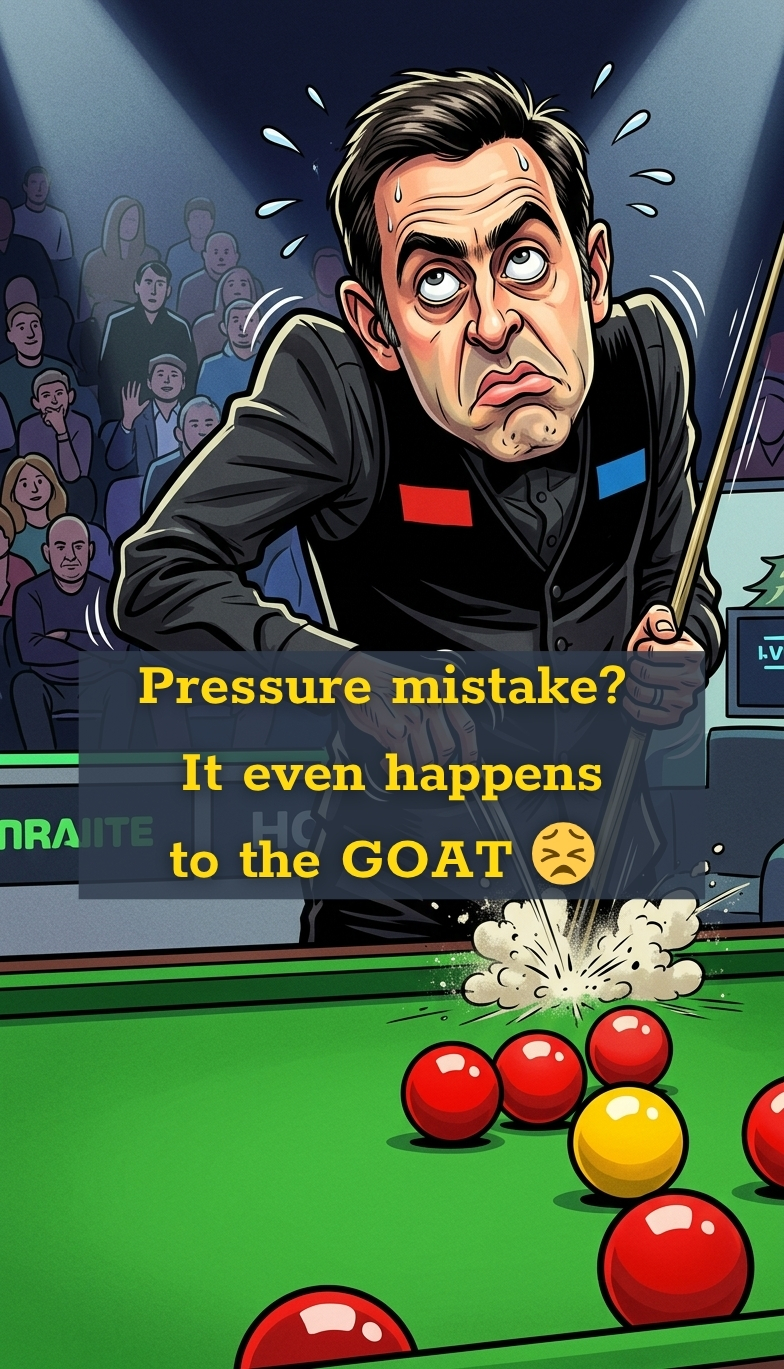
Pressure is a curious thing.
It's rarely constant. It ebbs and flows. It goes up and down depending on the situation: the score, the moment, the opponent, the audience, what the match means to you.
And here's the most interesting part: most of the time, you can handle those waves.
You have a buffer zone — a range where pressure can rise and fall and you still play "normal." You still see the table well. Your cue action stays clean. Your decisions feel natural.
But when pressure mounts just a little too much, you step outside that buffer zone.
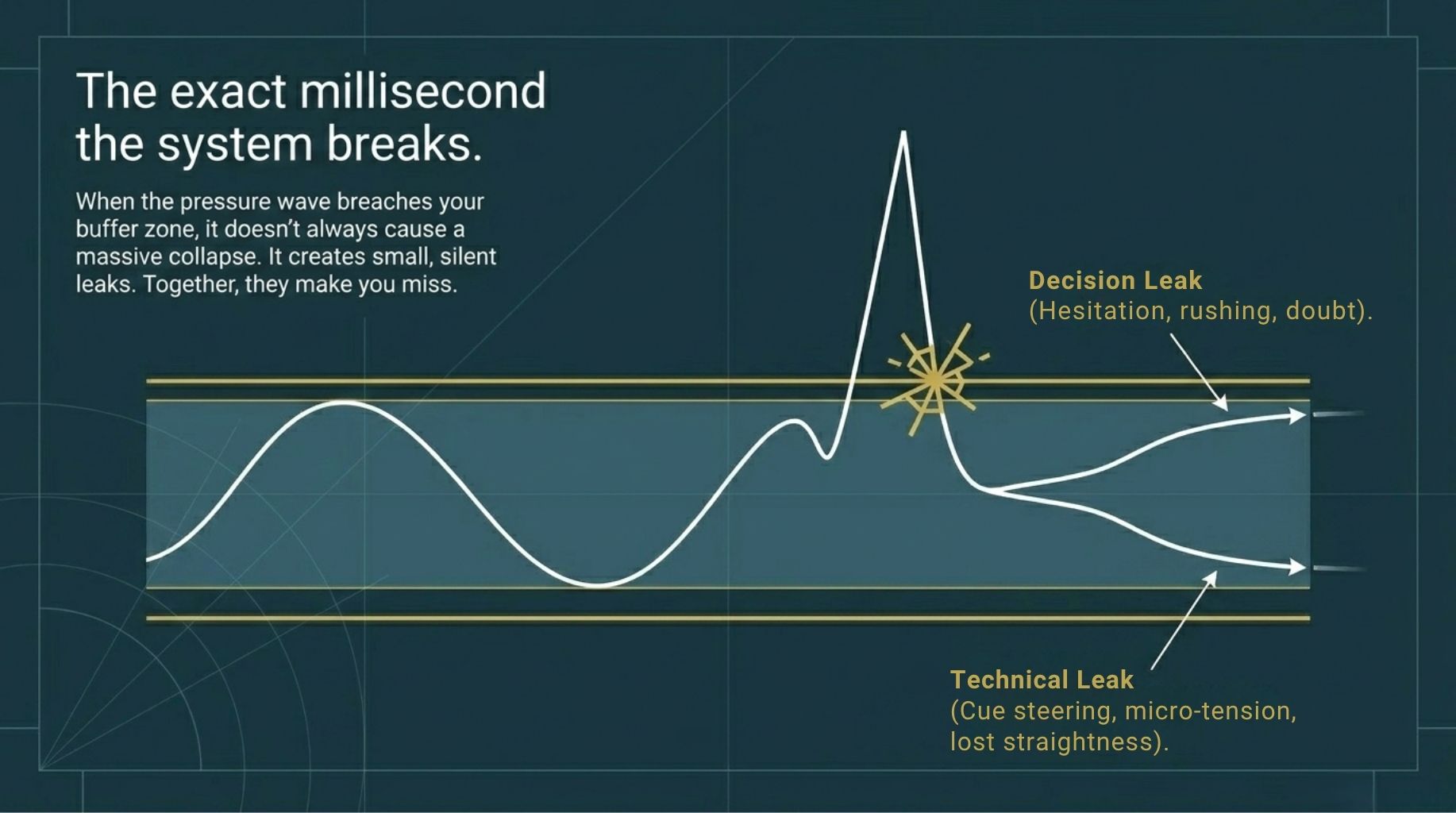
That's when the weird stuff starts.
- •Doubts you normally don't have
- •Small mistakes you "never" make
- •A cue action that suddenly isn't straight anymore
- •A rushed decision… or the opposite: hesitation
The moment pressure spills over: rare Ronnie O'Sullivan pressure shot mistakes
Yesterday I watched Ronnie O'Sullivan's first match at the World Championship.
He was leading 9–2, and in the last frame he got the opportunity to close the match. He got the first chance, started scoring, and around 20–0 he had a situation that wasn't ideally placed.
And you could see something shift.
He didn't immediately see the blue + the next red the way he normally does. There was a small pause. A small doubt. He eventually chose a solution.
Then he got a red that was relatively straightforward — not the easiest because of the distance, but still a shot he makes almost every day.
He missed.
If you look closely, you can also see something that's very telling: his cue action doesn't go nicely straight through the ball. There's a slight side movement. That's not "Ronnie standard."
And the curious thing is: two shots later, he gets a very similar position and makes the exact same mistake again.
That's what pressure does when you step outside your buffer zone.
It doesn't always create a big collapse. Often it creates a small technical leak and a small decision leak — and those two together are enough.
The shot is "easy" technically, but it's heavy psychologically.
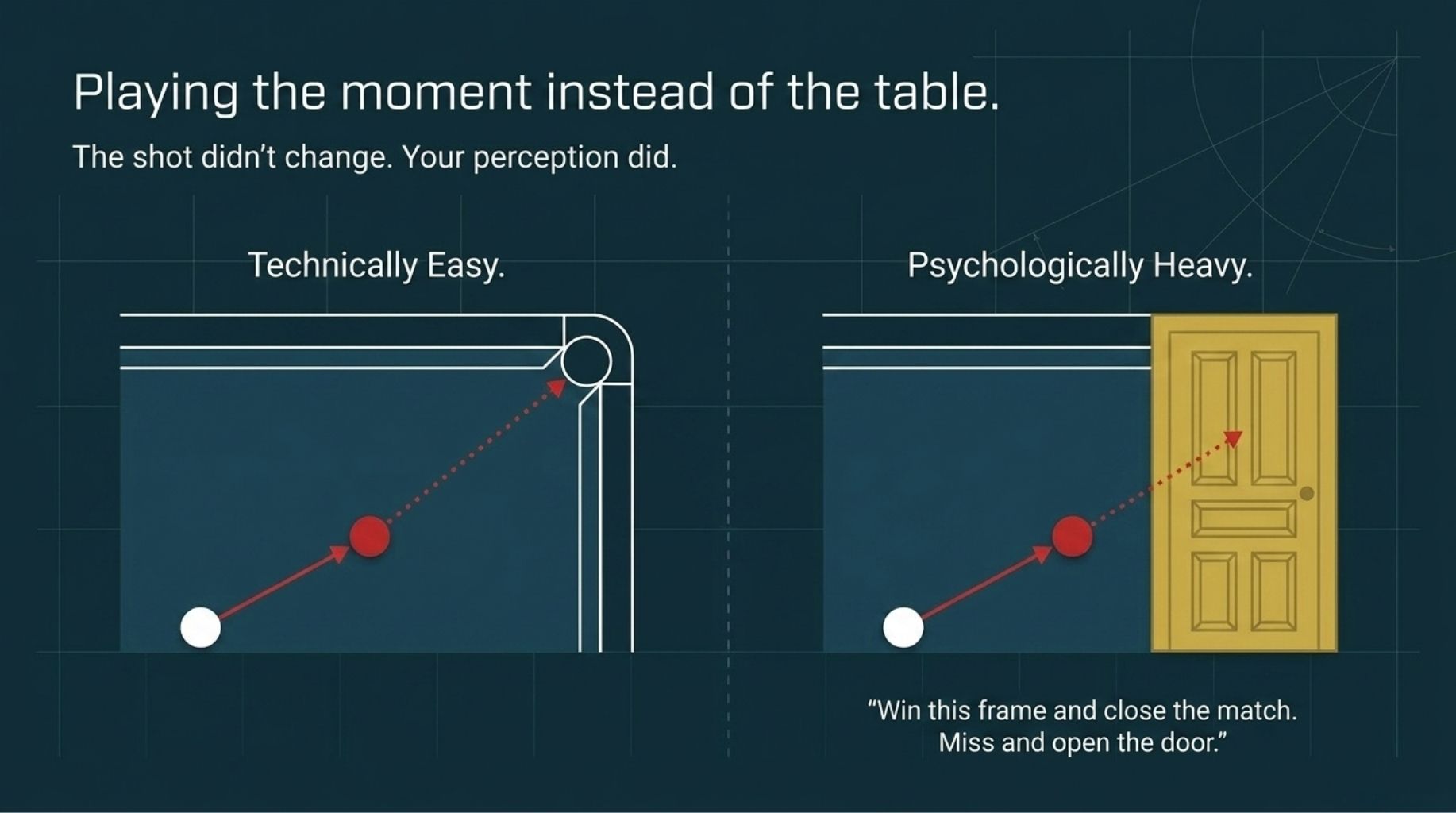
Because it's a finishing door:
- •Win this frame and you close the match
- •Miss and you open the door
- •And suddenly you're not playing the table anymore… you're playing the moment
(And yes — sometimes your opponent is nervous too, and you get another chance. But you don't want to build your results on luck. You want a system.)
What the buffer zone really is
Your buffer zone is the range where you can still execute your game under pressure.
Inside the buffer zone:
- •Your routine feels natural
- •Your eyes and mind stay on the process
- •Your cue action stays fluid
- •You commit to decisions
Outside the buffer zone:
- •You start "thinking your stroke" instead of trusting it
- •You steer the cue (micro-tension)
- •You hesitate or over-control
- •You feel urgency: "I have to finish now"
The goal of mental training is not to remove pressure.
The goal is to train two skills:
- •How to function when you're outside your buffer zone (fast recovery)
- •How to expand your buffer zone (so bigger pressure still feels normal)
Skill 1: How to function when you're outside your buffer zone
This is your "reset skill."
In billiards, pressure mistakes often come in clusters. Not because you suddenly lost your talent — but because you didn't interrupt the pattern.
Here's a simple 30-second reset you can train:
- •Name it: "I'm outside my buffer." (Labeling reduces chaos.)
- •Breathe: one slow abdominal breath, and a longer exhale (drop the tension).
- •Decision rule: choose your plan within 5 seconds, then commit.
- •One process cue: pick one anchor only (example: smooth through the line).
That's it.
Not ten thoughts. Not a full analysis. Just a short switch back to stability.
Skill 2: How to expand your buffer zone
You don't expand your buffer zone by only practicing when you feel good.
You expand it by training pressure reps on purpose.
Try one of these in practice (choose one and do it for 7 days):
- •Finish-the-frame drill: set up a simple run-out and tell yourself: "This is the last frame." If you miss, restart.
- •Consequence drill: every miss costs you something small (10 push-ups, 2 minutes break, or restart the rack). Your body learns that the moment matters.
- •One-chance drill: you only get one attempt per layout. No "best of three." This forces commitment.
The point is not to suffer.
The point is to teach your nervous system: "I can still be fluid when it matters."
Final thought
Pressure will always come in waves.
The question is: when the wave rises, do you stay inside your buffer zone — or do you spill over into doubt and technical leakage?
Train the two skills:
- •Reset fast when you're outside the buffer
- •Expand the buffer with pressure reps
And you'll stop being surprised by the shot you "never miss."
You'll start recognizing the moment earlier — and you'll have a routine that brings you back to your normal level.